


Patient Newsletter – September 2025

Mature Male Friends Socializing In Backyard Together

September: Prostate Cancer Awareness Month. Have You Been Screened?

The second-leading cause of cancer death in men is curable. But it’s also deadly. Here are the facts about prostate cancer:

  1. One in eight men is diagnosed with prostate cancer in his lifetime.
  2. One in six Black men is diagnosed with it in his lifetime.
  3. If caught early through a simple screening, most cases can be cured.
  4. But many men don’t get screened like they should.

Screenings: When? What happens?

Although you may not have any symptoms, you should begin getting tested for prostate cancer at age 50, or at age 45 if you are African American and/or have an immediate family member diagnosed with the disease. Screening looks like this:

Get re-screened as often as your doctor recommends.

Your next step

September is Prostate Cancer Awareness Month. If you, or someone you care about, is due for a screening, encourage them to find the nearest location and get it scheduled.

Read inspiring prostate cancer stories from our patients.


CT - Computerized Tomography Scan Device in Hospital. Medical Equipment and Health Care.

Breakthrough PSMA PET/CT Scan Improves Detection of Prostate Cancer

A new, more precise scan to detect prostate cancer is now available to Keystone Urology patients The PSMA PET/CT scan can detect cancer that is often missed by other scanning techniques. Currently available, the PSMA PET/CT scan is considered the single best method available today to locate cancer precisely. The PSMA PET/CT scan works like this:

The patient is injected with a radioactive imaging agent that finds and attaches itself to prostate cancer cells. The imaging agent is detected during the PSMA PET/CT scan, indicating exactly where the cancer cells exist in the prostate and in other areas of the pelvis. Knowing the exact location of the cancer cells allows for precisely targeted treatment.

The PSMA PET/CT scan can detect small cancer growths that may be missed during other imaging tests. It’s a powerful tool that’s enhancing cancer care.

If you or someone you care about may have prostate cancer, contact the Keystone Urology location nearest to you and ask if a PSMA PET/CT scan is right for you.


IR Center Offers Innovative BPH Treatment

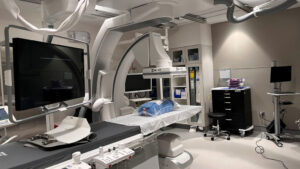
Groundbreaking treatment for an enlarged prostate is now available at our new Interventional Radiology (IR) Center in Chesterbrook, PA. If you or someone you love suffers from an enlarged prostate (BPH), a minimally invasive solution is now available.

Prostate artery embolization (PAE) removes the extra tissue in an enlarged prostate that can constrict or partially block a man’s urethra. The excess tissue can cause incontinence, urinary frequency, urgency, and other symptoms that affect quality of life. During the PAE procedure, tiny microspheres are inserted into the arteries that feed the prostate. In the weeks that follow, these microspheres slowly restrict blood supply to the prostate, reducing the prostate to a more normal size. Once this occurs, the urethra is no longer compressed, and urination returns to normal.

PAE is performed by interventional radiologist Dr. David Feldstein and his team of physicians, who use x-ray or other imaging techniques to guide instruments during the procedure. A small incision in the upper thigh is all that is needed. PAE takes about two hours.

Benign prostatic hyperplasia, 3D illustration showing normal and enlarged prostate gland

Why consider PAE?

  • Minimally invasive
  • No surgical incision or device inserted into the penis
  • Performed in an outpatient setting instead of a hospital
  • Requires no general anesthesia (only “twilight sleep”)
  • Lower risk of side effects such as erectile dysfunction, bleeding, and incontinence, compared to surgery

Ask your doctor if PAE is right for you. Learn more about PAE and what to expect.